When Jon and Karen Huntsman were building their log cabin chalet in Deer Valley, Utah, Karen knew that she wanted it to be Western “to represent the beauty of the West. I love the beauty and what it brings to our heart and soul.”
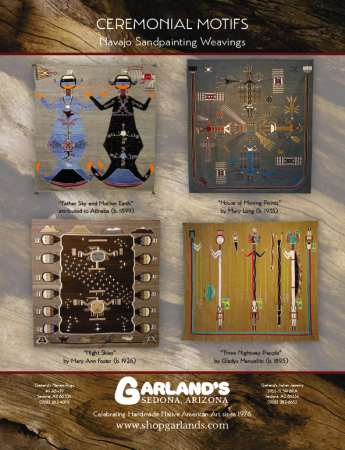
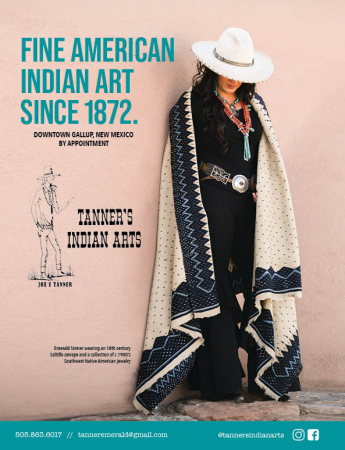
Karen was first attracted to Navajo wearing blankets, in which the artists had woven their love. “It just warmed my heart with each weaving. I felt so connected with the weavers.” Thus began a collecting mission with the help of Joe and Cynthia Tanner of Tanner’s Indian Arts in Gallup, New Mexico. Joe’s family has been trading with Native American artists since the mid-1800s.
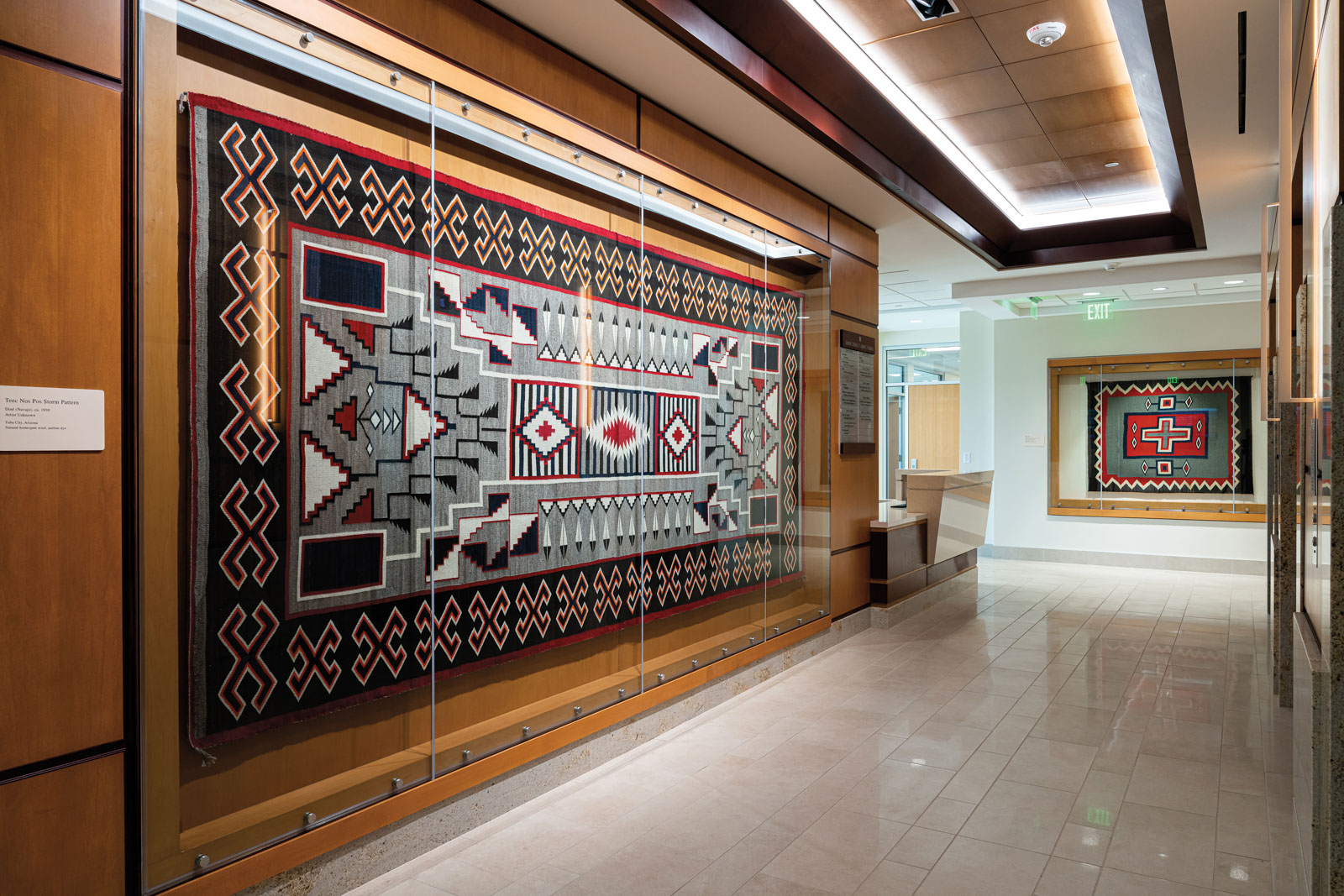 Teec Nos Pos Storm Pattern (Artist Unknown, Diné (Navajo), ca. 1930) on display on the seventh floor of the Kathryn F. Kirk Center at Huntsman Cancer Institute. In the background, Plate XX (Hastin Kellie Esklinigi Bitsee, Diné (Navajo), J. B. Moore Collection, 1930) is visible.
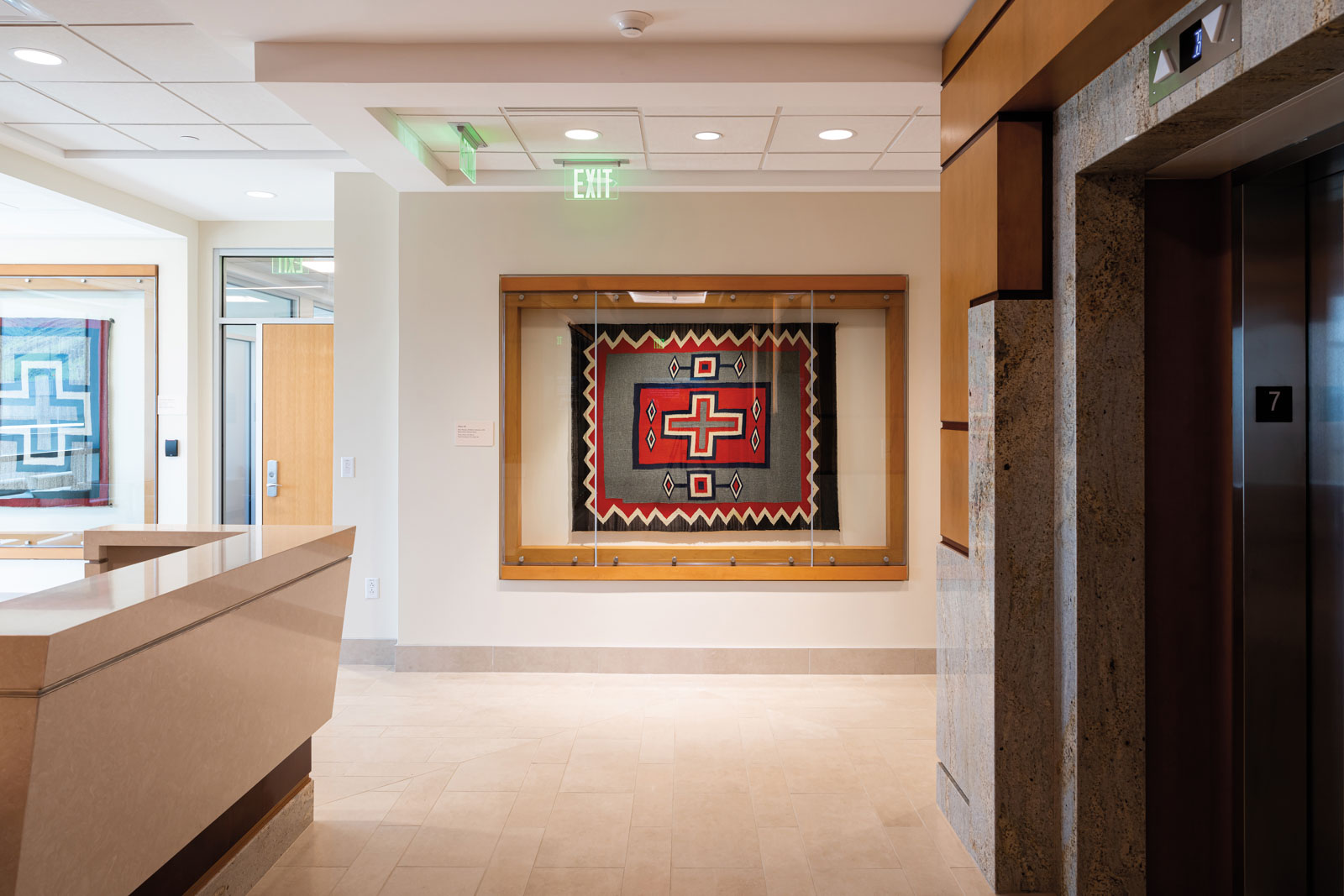 Plate XX (Hastin Kellie Esklinigi Bitsee, Diné (Navajo), J. B. Moore Collection, 1930) on the seventh floor of the Kathryn F. Kirk Center at Huntsman Cancer Institute. On the left, Crossroads Weaving (Artist Unknown, Diné (Navajo), ca. 1913-1919) is partially visible.
“When we started displaying in the cabin,” Cynthia recalls, “Joe decided to look for J.B. Moore weavings. Moore was the first to recognize Navajo weaving as a fine art.”
J.B. Moore had established the Crystal Trading Post in 1896 and, later, published a catalog of Navajo weaving styles and patterns available from the Navajo weavers at his post.
“We collected over a period of years,” Cynthia continues. “People knew we were trying to put this together; we searched and we would go to auctions. It just snowballed.”
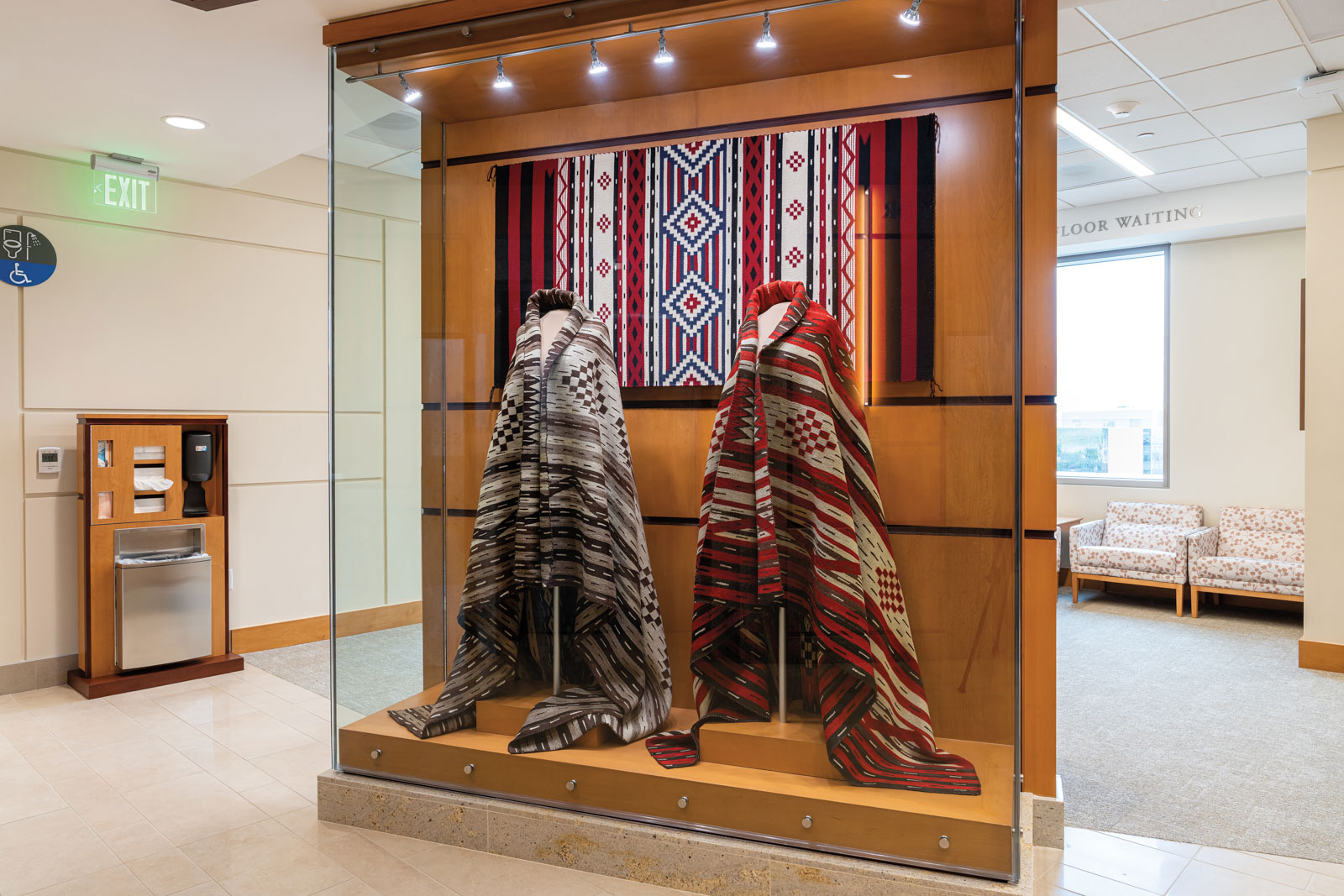 Crystal Wearing Blanket (based on Plate II, J. B. Moore Collection) (Bessie Yazzie, Diné (Navajo), ca. 1950); Plate II (Artist Unknown, Diné (Navajo), J. B. Moore Collection, ca. 1910); and Plate II (Artist Unknown, Diné (Navajo), J. B. Moore Collection, ca. 1900) located in the center of the waiting area of an inpatient care floor at the Kathryn F. Kirk Center at Huntsman Cancer Institute.
After the death of her husband, Karen Huntsman considered what to do with the collection. In conversation with Mary Beckerle, CEO of the Huntsman Cancer Institute at the University of Utah—which John and Karen founded in 1993—Mary suggested the collection could go into the Kathryn F. Kirk Center for Comprehensive Cancer Care and Women’s Cancers, then in the planning stages.
“That’s where this collection belongs,” Karen relates. “It belongs here to touch souls. As you walk into this building and feel the warmth of the weavings and the people who did them, I just hope it gives them hope, encouragement, love, because cancer can be so scary for so many people. I just think it’s going to make a huge difference.”
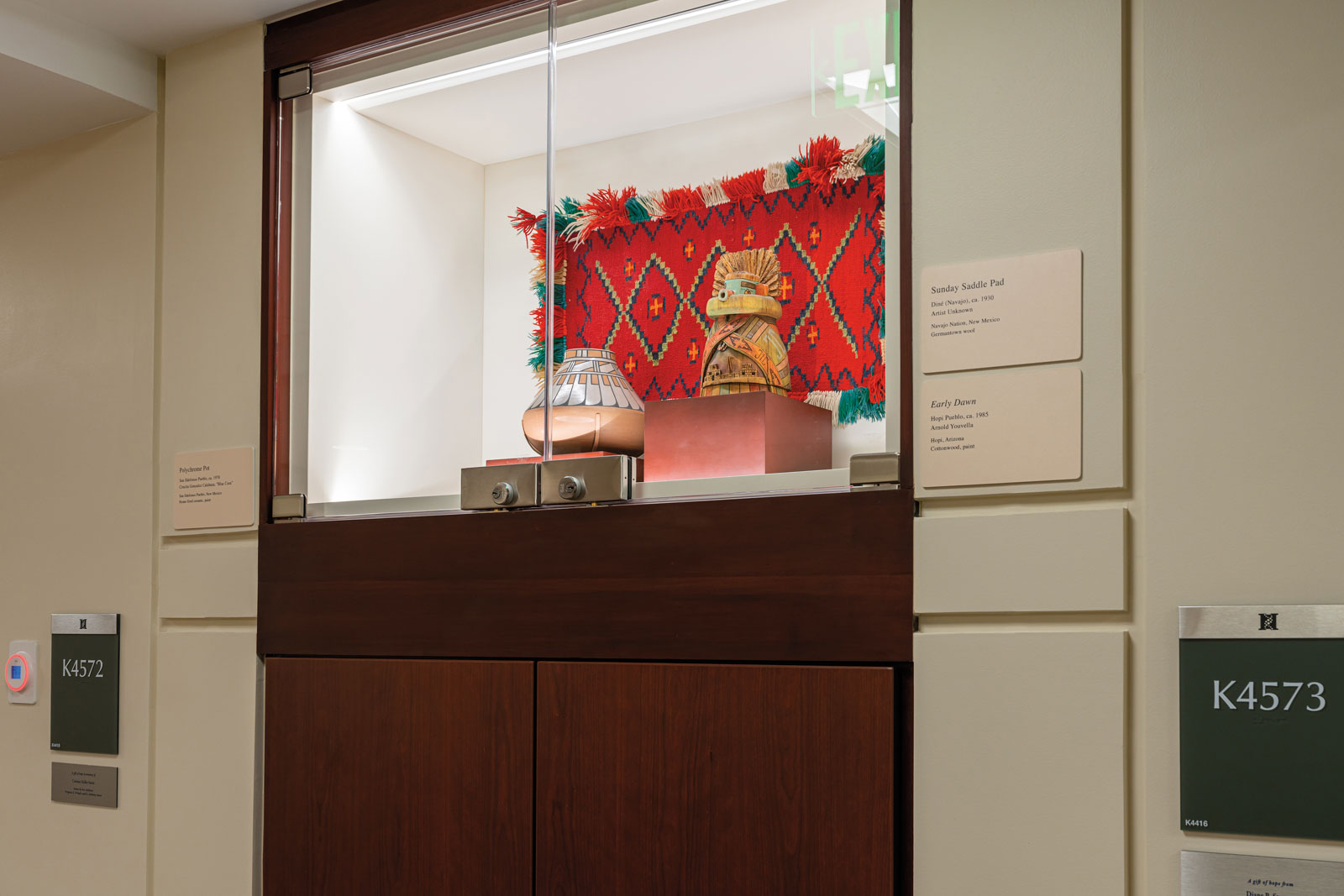 The area between each inpatient room at the Kathryn F. Kirk Center at Huntsman Cancer Institute houses an art case. The art at Huntsman Cancer Institute is intended to create a healing environment that surrounds patients in beauty. Pictured here, a polychrome pot (Crucita Gonzalez Calabaza “Blue Corn,” San Ildefonso Pueblo, ca. 1970), a Sunday saddle pad (Artist Unknown, Diné (Navajo), ca. 1930), and Early Dawn (Arnold Youvella, Hopi Pueblo, ca. 1985).
Don Milligan, executive director of the cancer hospital, accompanied by Lisa Ramidan of Architectural Nexus, the principal architect, went to Deer Valley to look at the collection. The public areas of the Kirk building were designed around the artwork,” he says. “Every public space was designed with artwork in mind. The architect created an organized catalog of the collection and worked out the initial placement of the art on walls, in cabinets and niches. The Tanners were involved at every step.”
Emerald Tanner, who had been a toddler when her parents were assembling the collection with the Huntsmans, played a principal role in the installation. “Certain pieces were programmed to go in certain spots,” Don relates. “Emerald would consider and then say, ‘That’s not quite right.’ After some adjustment she would say, ‘That’s right! That’s better and that piece feels happy.’”
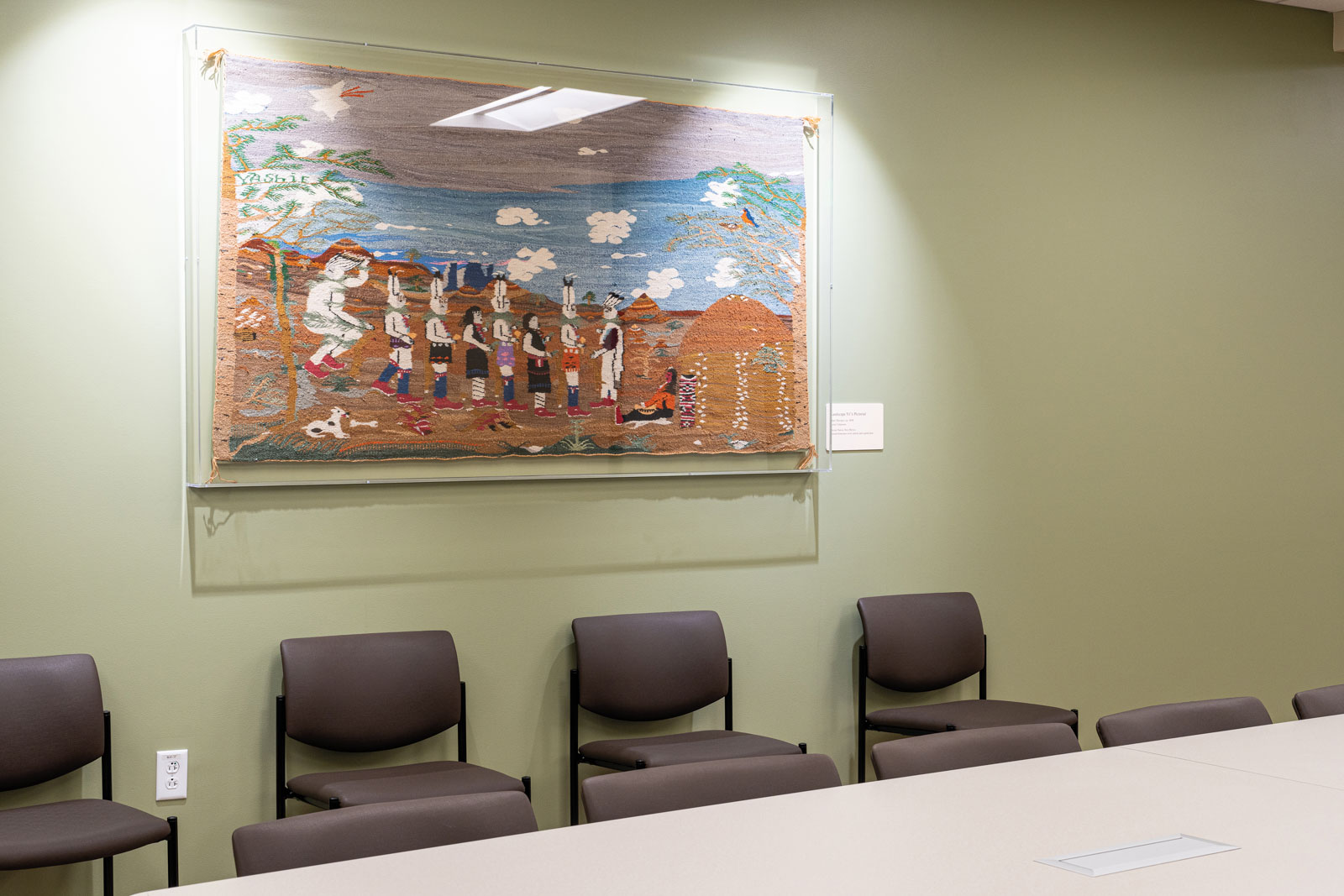 This Landscape Yé’ii Pictorial (Artist Unknown, Diné (Navajo), ca. 1938) is located in the staff workroom of the Blood and Marrow Transplant Unit. This space will be used to coordinate care for some of Huntsman Cancer Institute’s most medically fragile patients. This pictorial is made from natural homespun wool, with a mix of aniline and vegetal dyes.
Cynthia Tanner told her daughter, “The pieces know you and they’re telling you where they want to be.”
Emerald says, “It’s just been an incredible honor to be able to handle them again and to ask them where they would like to be presented…to share these pieces with the patients and the staff. It’s beautiful. It’s a love story.”
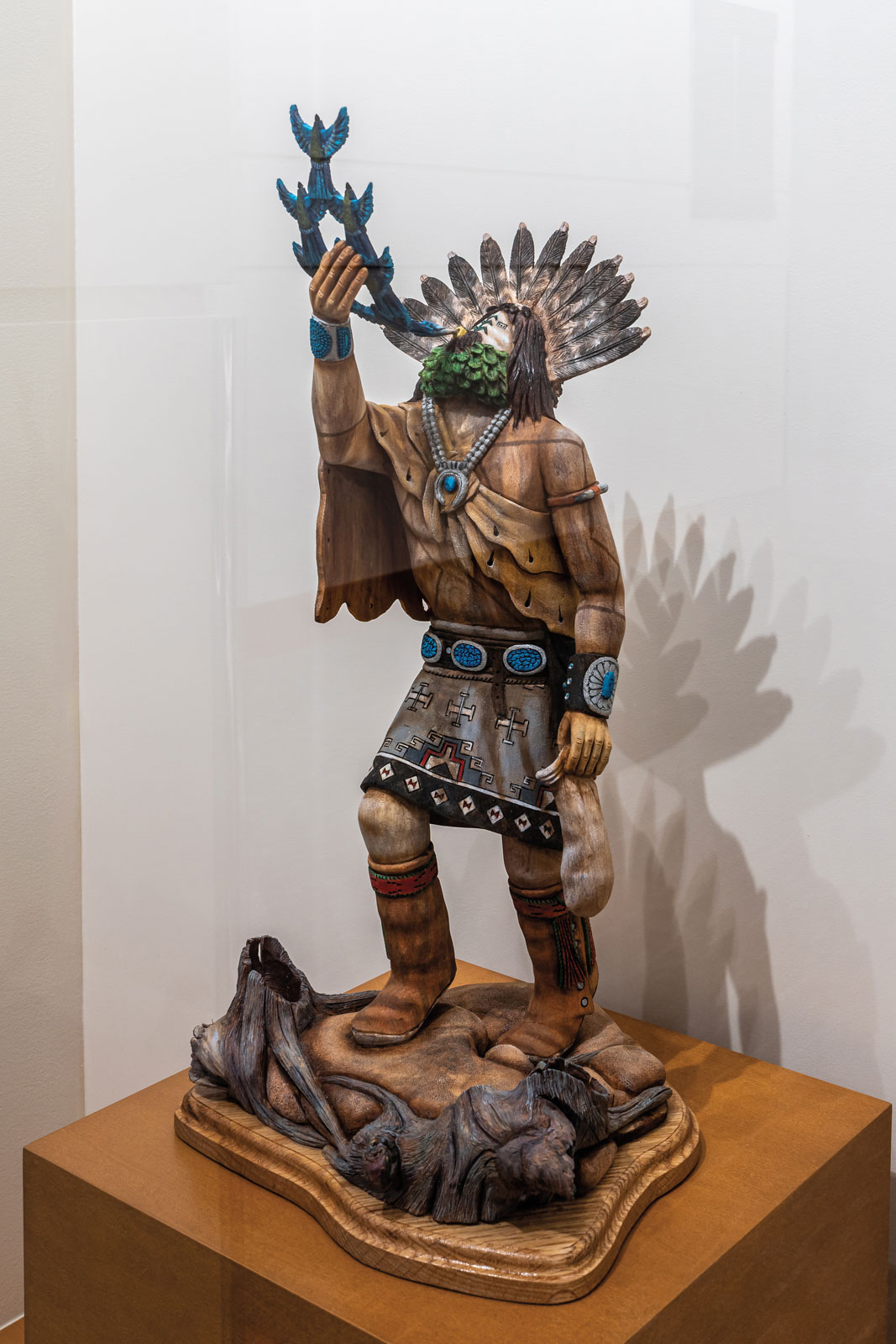 Blue Bird Song (Cecil Miles, Diné (Navajo), 2023) was created by artist Cecil Miles specifically for the Kathryn F. Kirk Center at Huntsman Cancer Institute as a symbol of peace, healing and happiness. This piece, made of cottonwood and paint, is located in the third-floor surgical waiting area.
Joe Tanner relates, “Sixty percent of the time that is spent in the creation of any one of these single pieces of weaving is the preparation of the wool and each of those weavers has that song in their heart. That’s enormously important.” The song relates to the Navajo concept of Hózhó, harmony with the world.
Emerald explains, “That song is ‘Beauty before me, below me, beside me and all around me.’ It’s the concept of Hózhó in the weave. It’s the spirit of the weaver, the enormous respect that the artist has not just for the culture but for the ancestors, for the land, giving that individual weaving—be it a wearing blanket, be it a wall piece—an identity and an inner spirit.”
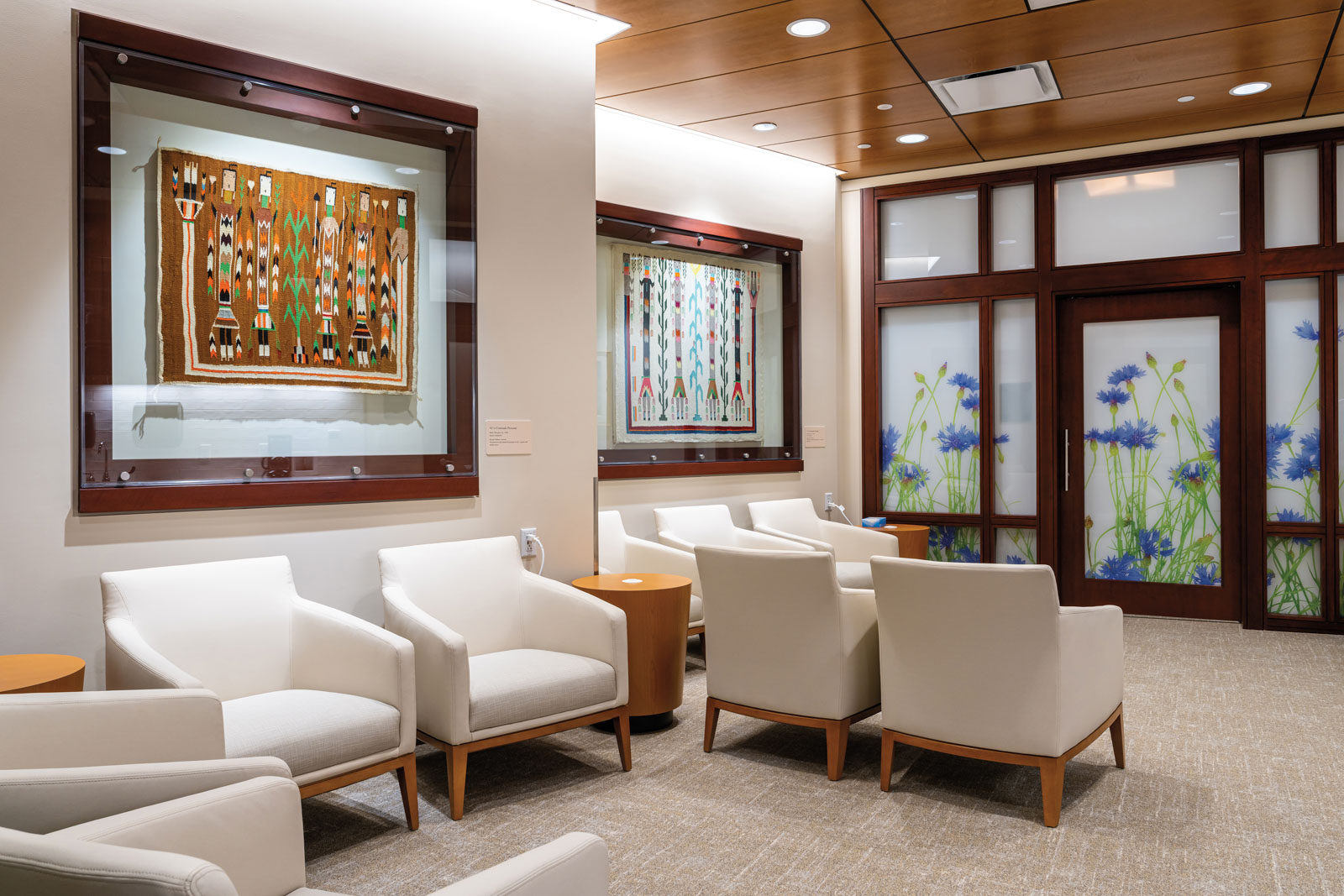 Two Yé’ii cornstalk pictorials (Artists Unknown, Diné (Navajo), ca. 1930 and ca. 1935), located in the mammography waiting area in the Kathryn F. Kirk Center at Huntsman Cancer Institute.
James Buck King (1951-2019, Navajo (Diné)) painted Portrait of Nellie, a portrait of his grandmother, which is now displayed prominently in the center. It is one of Karen Huntsman’s favorite paintings. The label reads, “The Diné are a matriarchal society, where Naabeehó sáanii (Navajo women) are the center of the family, keepers of wisdom, and preservers of ancestral teachings.”
The Kirk Center opened in May. Don Milligan relates, “One of the common things I see and which is just wonderful, is patients and their families being captivated by the Native artwork. I see them appreciating the work and spending time looking at it and reading the descriptions. Soon we will have QR codes on the labels that will lead people to even more information about the art and the artists.
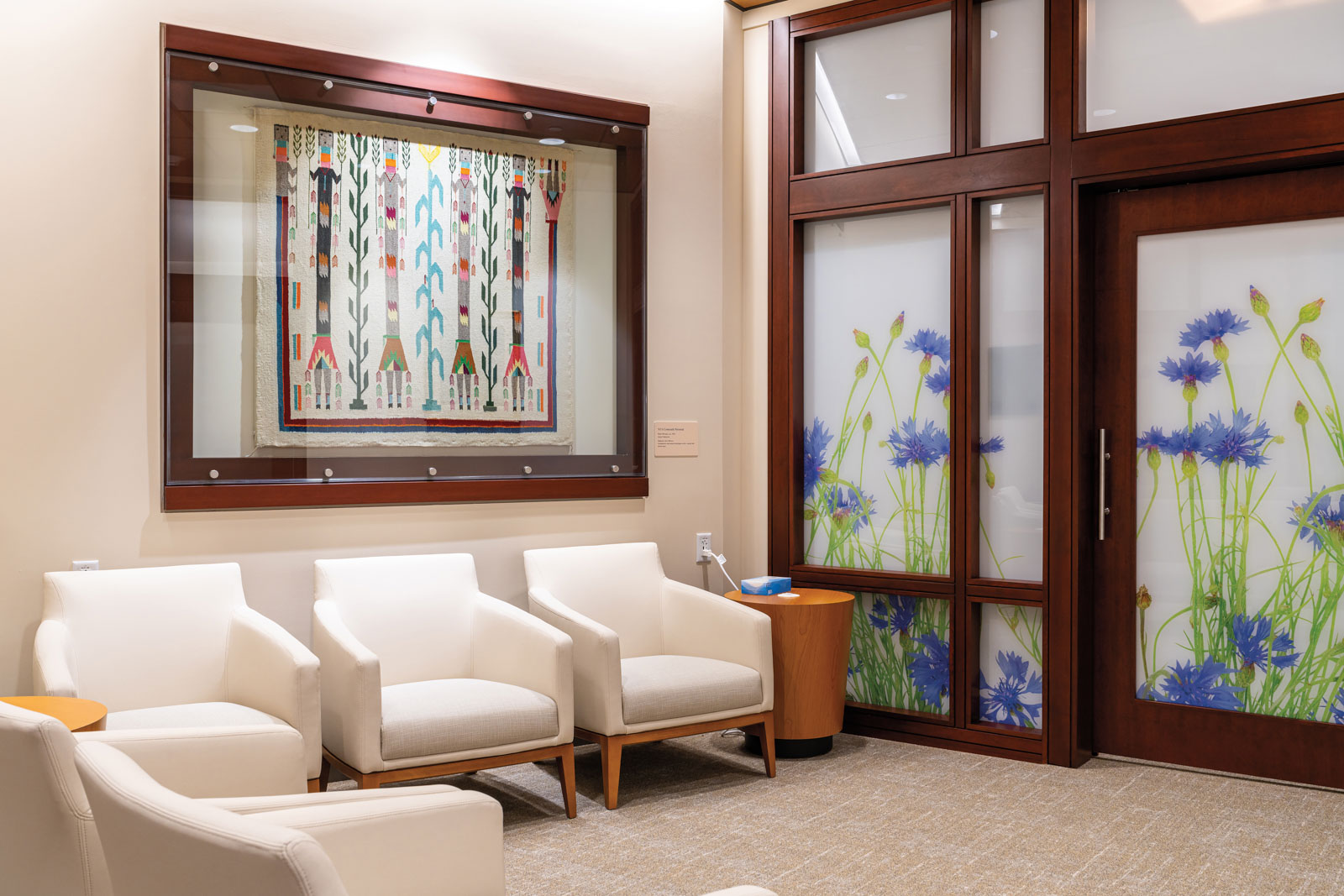 Yé’ii Cornstalk Pictorial (Artist Unknown, Diné (Navajo), ca. 1935), is located in the mammography waiting area in the Kathryn F. Kirk Center at Huntsman Cancer Institute. This space, designed to feel relaxing and spa-like, is where patients wait in robes prior to mammogram screenings.
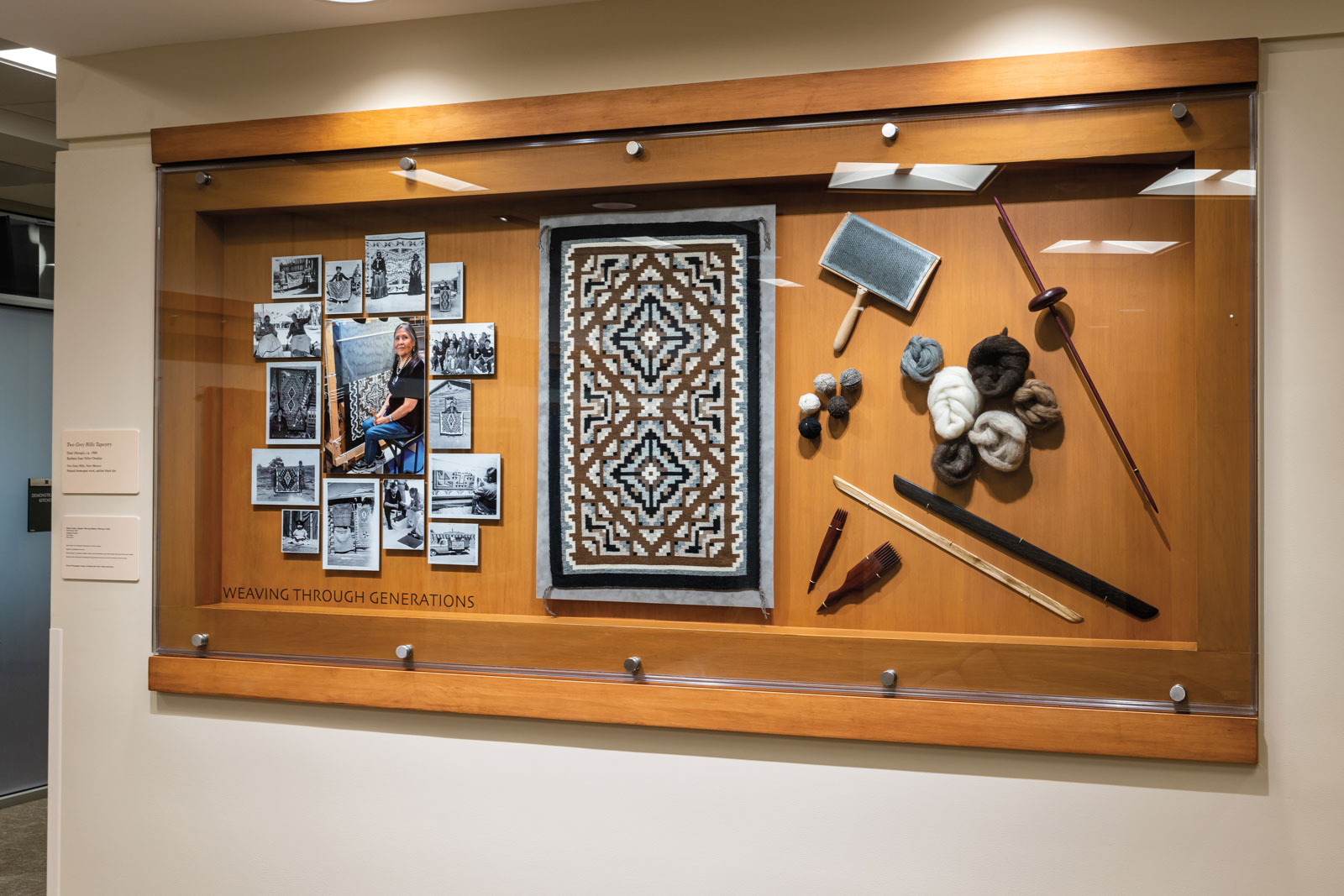 This display, located in the waiting area of the Wellness and Integrative Health Center at the Kathryn F. Kirk Center, helps visitors learn more about the weaving process, as well as the work of fifth-generation Navajo weaver Barbara Jean Teller Ornelas. Included in this display are photographs of Teller Ornelas with multiple generations of her family, a display of weaving instruments, and Two Grey Hills Tapestry (Barbara Jean Teller Ornelas, Diné (Navajo), ca. 1980).
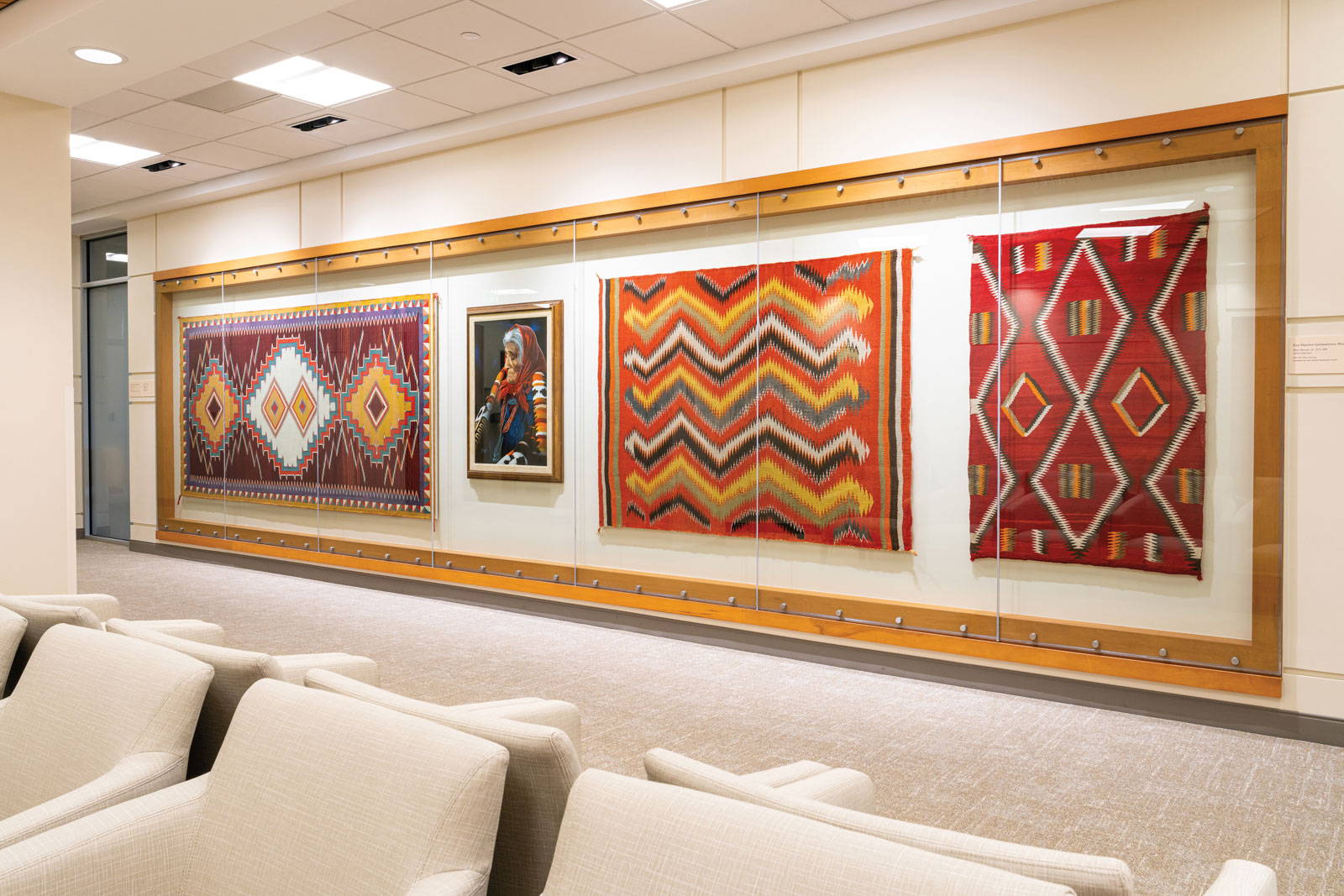 Spanning a large wall in the waiting area of the Wellness and Integrative Health Center at the Kathryn F. Kirk Center, this case houses multiple vibrant weavings, as well as a painting by James Buck King. From left to right: Large Germantown Hubbell (Artist Unknown, Diné (Navajo), ca. 1890-1910), Portrait of Nellie (James Buck King, Diné (Navajo), ca. 1980), Germantown “Eye Dazzler” (Artist Unknown, Diné (Navajo), ca. 1875-1890), and Germantown Wearing Blanket (Artist Unknown, Diné (Navajo), ca. 1890).
“The collection is complementary to the healing process. If people are unfortunate enough to have to be in a cancer hospital, they ought to feel comfortable and peaceful. The Native American artwork lends itself to that.”
All pieces are part of the Jon M. and Karen H. Huntsman Family Collection.
One of the displays, “Weaving through Generations,” contains samples of churro wool and the tools used to prepare it for weaving. A photograph of the fifth-generation weaver Jean Teller Ornelas (Diné/Navajo) is displayed next to her Two Grey Hills tapestry and is surrounded by photographs of multiple generations of her family.
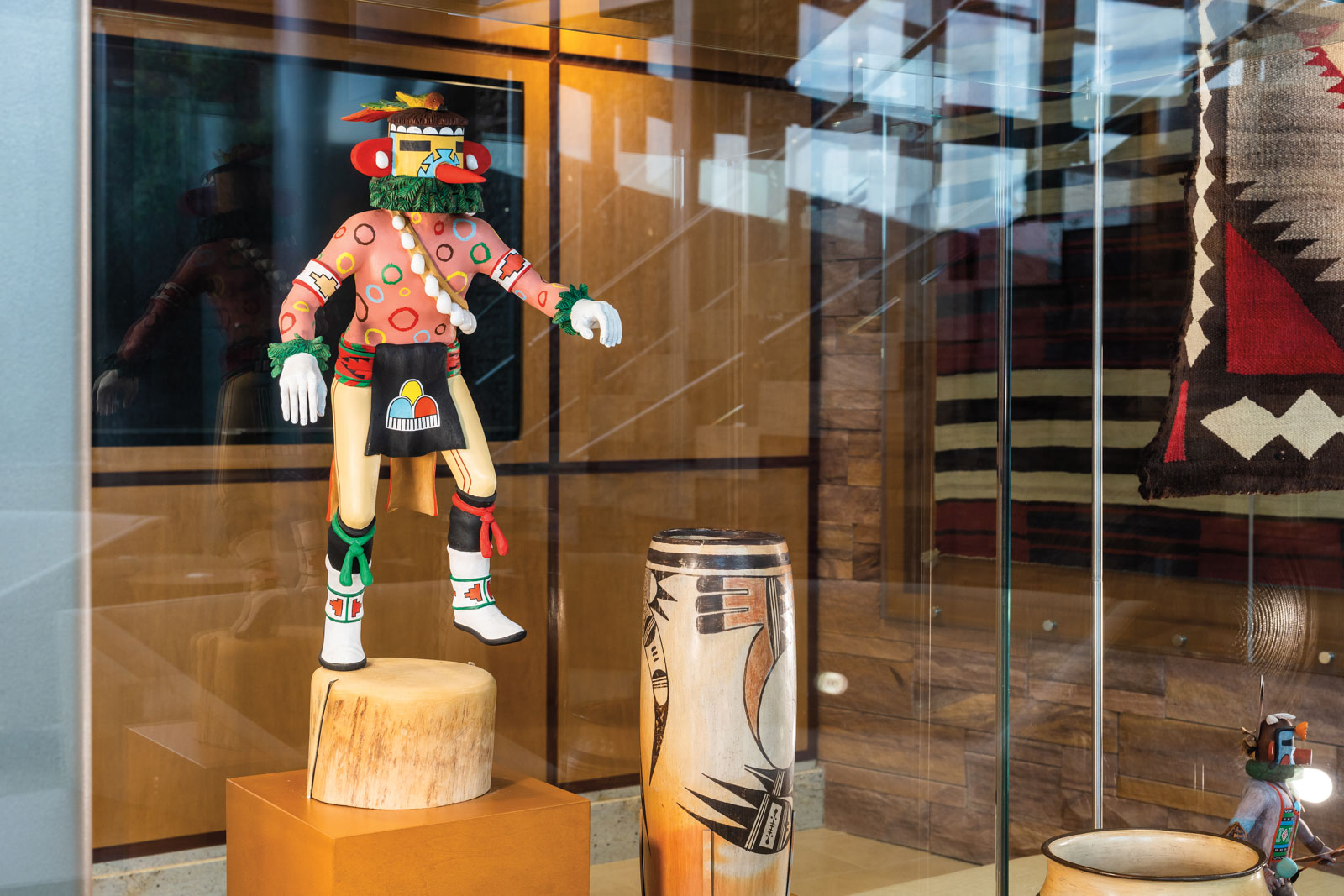 This Corn Dancer Katsina (A. L. Sahme, Hopi Pueblo, ca. 1970) is featured in the two-story glass case that welcomes visitors to the Kathryn F. Kirk Center for Comprehensive Cancer Care and Women’s Cancers at Huntsman Cancer Institute.
Jean says, “To me, weaving is healing. It is something that helps people by calming their gaze and helping them heal. I want viewers…to look at the weaving through the eyes of love. The spirit contained within the weaving will give the viewer peace.”
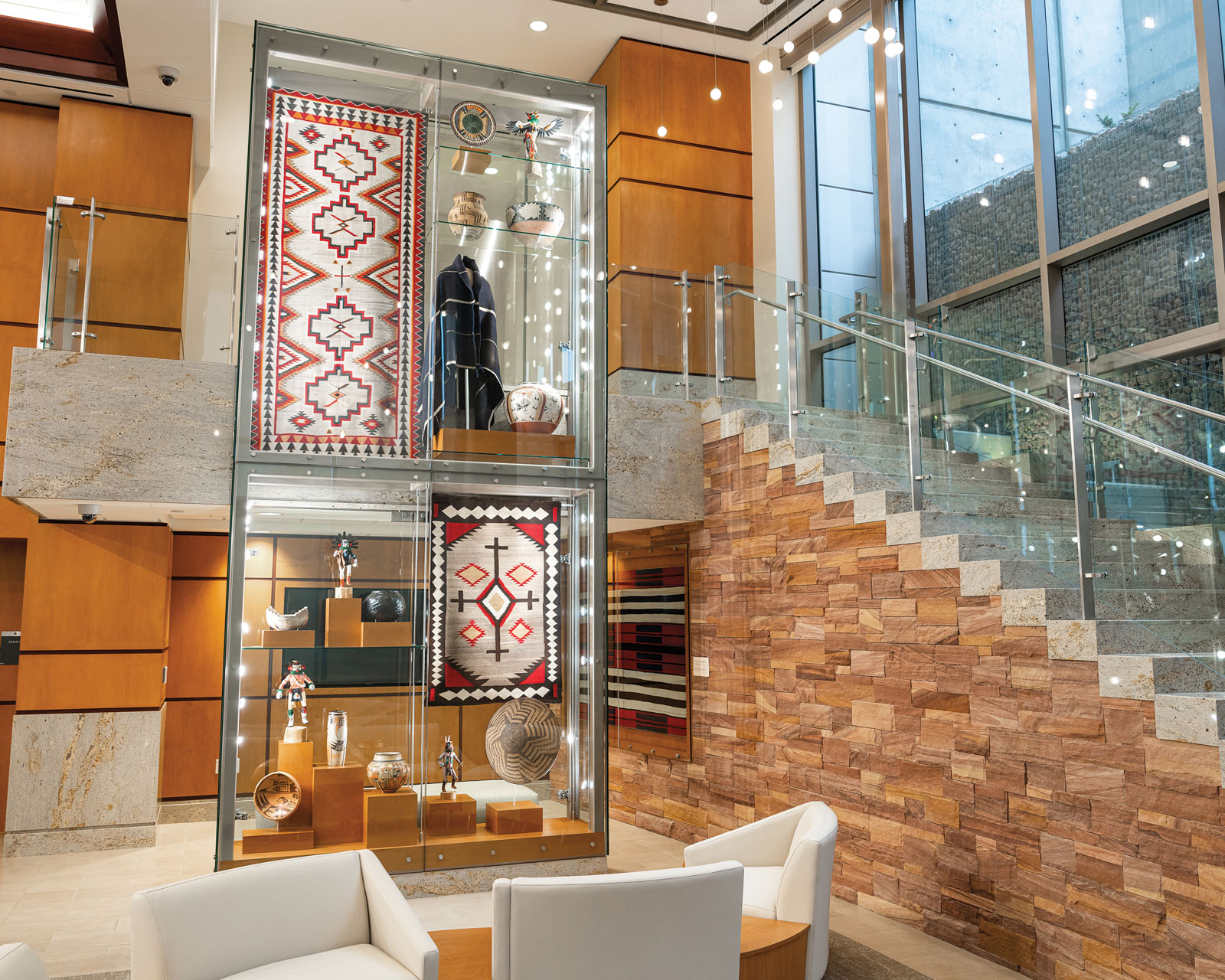 When patients and visitors enter the Kathryn F. Kirk Center at Huntsman Cancer Institute via the lobby, they are greeted with a two-story glass case housing a variety of art pieces. This case is designed to introduce the other pieces in the collection patients will see during their visit. The case includes weavings, pottery, a wearing blanket, baskets and katsina dolls.
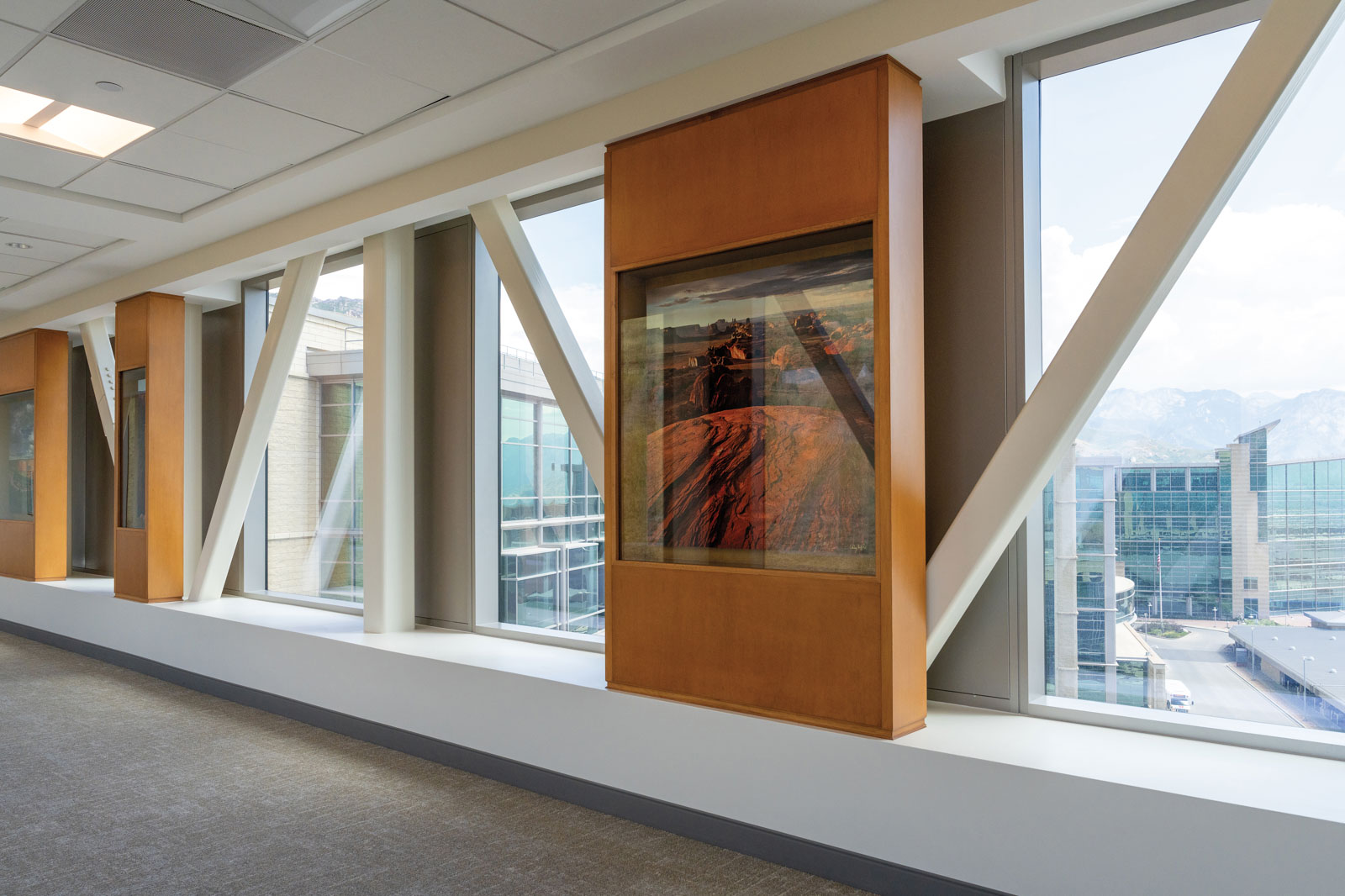 A display of landscape portraits by photographer Leroy DeJolie on the sixth-floor skybridge of the Kathryn F. Kirk Center at Huntsman Cancer Institute provides a connection to the lands where many of the art pieces on display were created. This photo is part of a series called Images of Navajoland and features Monument Valley in Utah and Arizona.
MORE INFORMATION
The Huntsman Cancer Institute’s website contains a wealth of information on the collection and resources for exploring Native American art. Visit it here: healthcare.utah.edu/huntsmancancerinstitute/about-us/art
Powered by Froala Editor